Whether Absolute Pacifism is a Practical Philosophy
In this article, I will go over why or why not absolute pacifism is a practical philosophy, and I will attempt to mimic the structure of the Scholastics in order to give a clear answer.
Objection One. It would seem that absolute pacifism is the only pragmatic response to modern warfare. In the modern era, war is rarely justified and is often only decreed for economic or political advancement instead of the necessities of a nation, while political leaders conceal their intentions under the guise of “justice.” Furthermore, modern warfare is far bloodier and more destructive compared to historical conflicts, making proportionality and discrimination nearly impossible to satisfy. Technological innovations, such as drone strikes, cause the death of men to be impersonal, which violates Jus in Bello. Moreover, the unpredictable nature of modern warfare has in recent history led to long-lasting ecological and economical devastation that is entirely contrary to the potential for good. Thus, all nations should be devoid of military force.
Objection Two. It would seem that absolute pacifism is the only true application of the teaching of Christian charity. In the Beatitudes, which personify the Image of God and His love, Christ states that “Blessed are the peacemakers, for they will be called the children of God” (Matthew Chapter 5:9). This is further emphasized in the same chapter by His command to “not resist one who is evil” and to “turn the other cheek” (Matthew 5:39). Furthermore, Christ does not resist His arrest in the garden of Gethsemane and rebukes Peter when he cuts off the ear of the soldier, saying, “Put your sword back into its place; for all who take the sword will perish by the sword” (Matthew 26:52). If Christ, who is ultimately innocent, did not resist, it follows that any use of force to defend oneself or others is a rejection of the Cross itself.
Objection Three. Violence is often followed with further retaliation.
Objection Four. Humans should be able to live in a utopia of complete peace in avoidance of mass genocide and suffering. It is simply the restraint of an oppressive government, one that merely uses tyranny and violence, that limits the possibility of such a utopia.
Sed Contra, the act of a restraint or a forceful response is not inherently evil. Furthermore, Scripture suggests that wrath, if necessary, should be inflicted on evil and evildoers (Romans 13:4).
Respondeo dicendum quod, Absolute pacifism is not a practical philosophy due to its misunderstanding of the very nature of peace. Peace is not merely the absence of an aggressor but is founded on the dignity of the human person and is naturally attainable only by right order, which is brought about by justice. Furthermore, it is important to define an aggressor–that is, in a broad sense, one who disturbs or breaks the order of justice within a community or between two persons. One must ask how just order is to be properly re-established once destroyed. I say that one should act in such a manner that restores order when a certain conflict is brought about, with the ultimate intent of restitution and the preservation of the common good (such as in the case of self-defense). In regard to war, a nation should wage war if all non-violent alternatives, such as diplomacy or sanctions, have been exhausted. Further, there should be legitimate authority–that is, those who take care of and are responsible for their community. Grave harm against a nation, harm which detracts from both the integrity and the personhood of the innocent, must be responded to in a forceful manner.
Absolute pacifism, which is the belief that no forceful action should be taken in any circumstance, is contrary to actively seeking to restore order and undermines the right of individuals amongst a community to preserve the common good as well as the dignity of other individuals and oneself. In the case of a governmental conflict, this sense of maintaining the common good extends not only to the efforts found in the individual members of a society, but also the legislative powers of that nation. Absolute pacifism, if applied universally, would allow the destruction of the innocent and therefore would not preserve the common good, which is contrary to the Fifth Commandment. It further allows an aggressor to disturb the order of justice and charity, rendering absolute peace unattainable. Thus, absolute pacifism is not only impracticable but also detrimental towards peace.
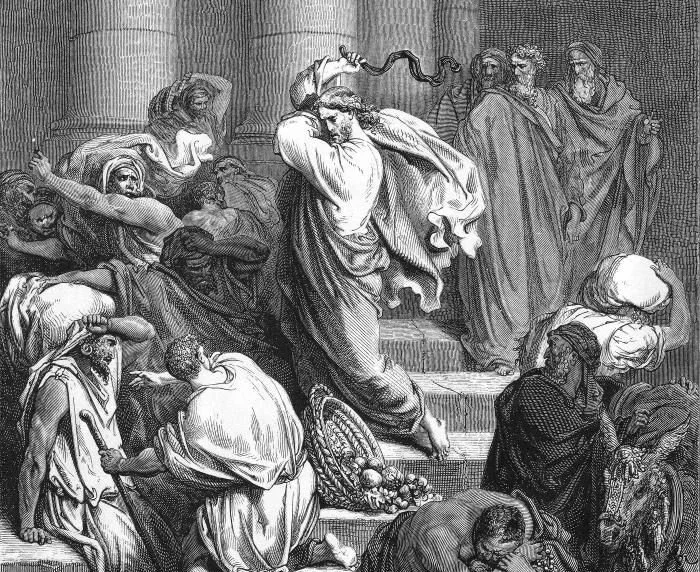
Jesus entered the temple area and drove out all those engaged in selling and buying there. He overturned the tables of the money changers and the seats of those who were selling doves.
Matthew 21:12-13
Reply to Objection One. Although modern warfare demands a stricter sense of proportionality (jus in bello), which is vital to just war theory, it does not negate the right to self-defense (jus ad bellum). Furthermore, the lack of right use of authority does not diminish authority in itself (e.g., “render to Caesar what is Caesar’s”). A leader who decrees war in an unjust matter–whether for political or economic advancements beyond necessities or oppression–would simply decree an unjust war. That said, the frequency of this act does not render all wars unjust. Additionally, any advancement in the ability of military weaponry will only be further impersonal. For example, the transition from using swords to guns was originally seen as undignifying yet was later normalized. If, in fact, a nation is called to preserve the common good of their community, they must do so effectively, which may include excluding weapons that “uphold” an opposing soldier’s dignity (while, of course, limiting both civilian deaths and the committing of war crimes). In this, a nation that has the ultimate intent to pursue the rehabilitation of order and the potential for good would not be acting in accordance with an injustice.
Reply to Objection Two. Christ’s precepts regard personal vengeance, which is not contrary to the public duty of preserving the common good. In the case of Peter, Christ did not permit him to attack the soldier out of recognition for His own personal duty to be the ultimate sacrifice for the salvation of all souls. Thus, Peter did not have the just authority to strike the soldier. In regard to defending oneself and others, true Christian charity demands the protection of the innocent and not merely being subjugated to the violence of an aggressor by means of passivity. It is virtuous to endure injustice namely for the sake of order and, ultimately, for the sake of Christ. Historically speaking, turning the other cheek did not mean the allowance of oneself to be walked on and trampled over by others. Romans would often smack with the back of their hands in order to humiliate inferiors, such as slaves. By turning the other cheek, the oppressor is forced to smack with the front of their hand, signifying a sense of equality and not subjugation. Additionally, Christians are called to correct out of love for the aggressor in order to return the them to the good and not simply abandon them in their injustice. We see even Christ Himself, when driving out those who were abusing the temple, used a just force and anger to rehabilitate order and reverence (Matthew 21:12-13). In this, Christ says to “love thy enemy” (Matthew 5:44).
Reply to Objection Three. If anything, absolute pacifism invites unchecked evil and allows aggressors to perpetuate violence without consequence. Instead, a just force restrains the further provoking of violence against the innocent and does not have the intention of destruction.
Reply to Objection Four. Due to the fallenness of human nature, the enforcement of justice is required to achieve true peace. The desire for sin renders a complete and unending utopia impossible, unless it is the will of God. The desire for such a utopia, although presumably noble, stems inherently from a place of ignorance and not practicality. It, in itself, with the absence of God, is the personification of humanity not wanting to be “chained” or ordered, which is directly contrary to the true peace intended by God. That said, God does not desire mass genocide, and it is by the weakness of men that this is brought about. Thus, if it is a last and necessary resort, forceful action should be taken to contrast with and correct evil.
© 2025 Christus Dominus Est. All rights reserved.
This article was written by Pietro Forti, a member of Ave Christus Rex.
Do not reproduce without permission. Sharing with attribution is encouraged.